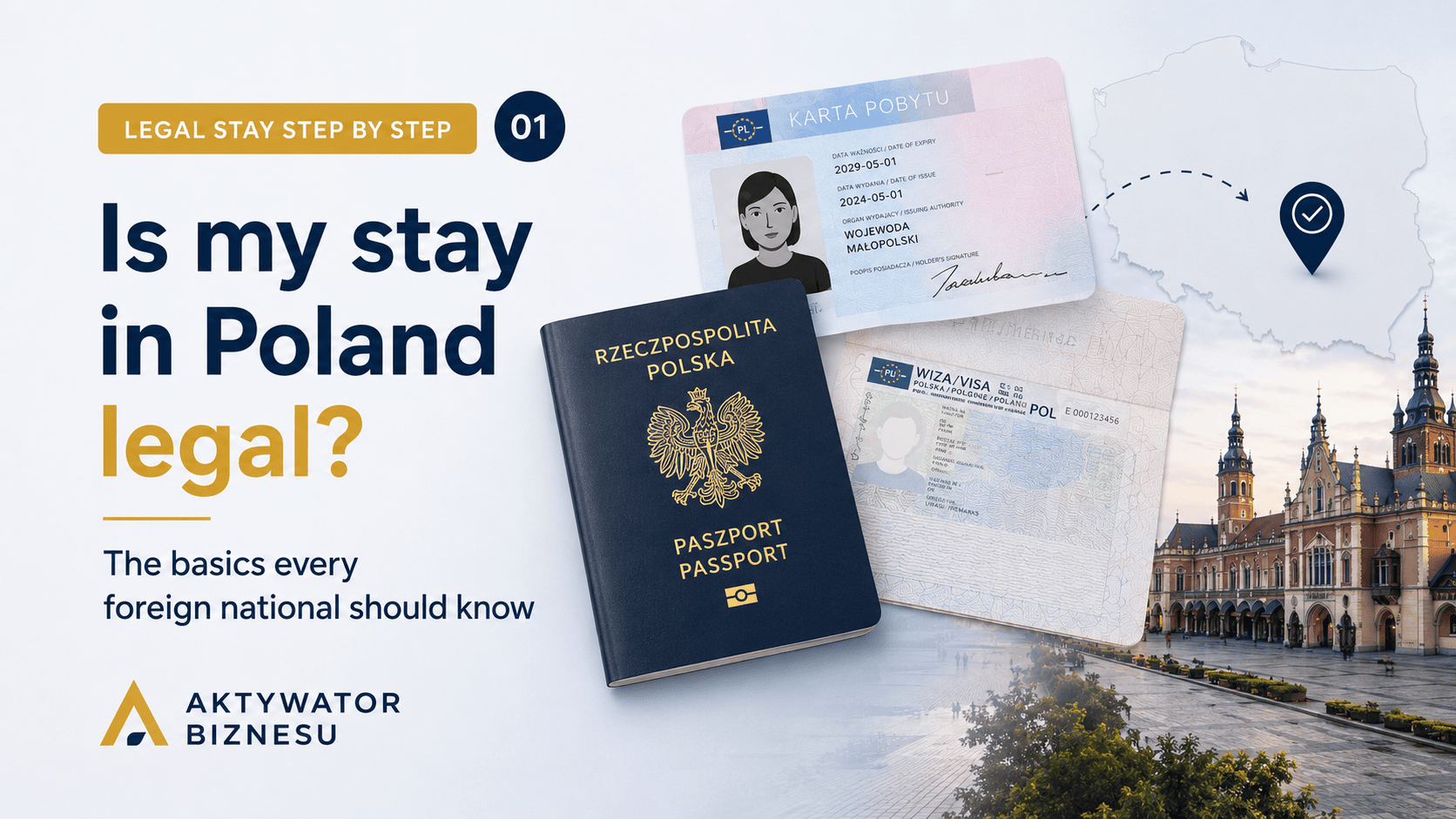
Is My Stay in Poland Legal?
LEGAL STAY STEP BY STEP · 01/12
Most common bases of legal stay
Check now
- ✅ Your date of entry into Poland
- ✅ Type and expiry date of your document
- ✅ Have you submitted an application?
- ✅ Do your documents allow you to work in Poland?
- ✅ When does your legal stay end?
In this series
- Is my stay legal?
- The 90/180-day rule
- Visa, decision, and residence card
- When to submit your application
- Legality during proceedings
- MOS Certificate
- Leaving during the wait for a residence card
- Change of address and situation
- Legal stay vs. legal work
- Changing employer during temporary residence
- Job change or loss
- Residence legality audit
Whether your stay in Poland is legal depends on the basis on which you entered the country and the basis on which you currently reside here. Your document expiry dates, travel history, the stage of any residence proceedings, and changes in your professional or family situation all matter as well. A PESEL number, a registered address, an employment contract, or a pending case number are not always enough on their own to consider a stay legal.
To check your situation, answer four questions:
- On what basis are you currently staying in Poland?
- Until when is that basis valid?
- Did you correctly apply for further stay?
- Has your situation changed since you entered the country or obtained your document?
Table of contents
- What does legal stay in Poland mean?
- The 90/180-day limit and the right to stay
- The most common bases for legal stay
- Residence permit vs. residence card – is it the same document?
- I filed a residence card application – is my stay legal?
- Frequently asked questions
- How to check the legality of your own stay
- The most common mistakes foreign nationals make
- When is it worth consulting your situation?
- Summary
Visa-free travel
Max. 90 days within any 180-day period across the whole Schengen area.
Schengen type C visa
Check validity dates, day limit, entries allowed and territorial scope.
National type D visa
Allows a longer stay under the conditions shown on the visa sticker.
Residence card
Confirms a residence permit – check the decision, not just the card date.
Waiting for a decision
A correctly filed application can keep your stay legal while pending.
Other bases for stay
EU citizens, long-term residents, and special-status provisions.
What does legal stay in Poland mean?
Legal stay means a foreign national holds a valid basis authorizing them to reside in Poland and complies with the conditions arising from that basis.
The basis for stay may include, among others:
- visa-free travel;
- a Schengen type C visa;
- a Polish national type D visa;
- a temporary residence permit;
- a permanent residence permit;
- an EU long-term resident permit;
- the right of residence of an EU citizen or their family member;
- a residence document issued by another Schengen state;
- a correctly filed application for a residence permit;
- special provisions applicable to certain groups of foreign nationals.
Not every one of these bases grants the same rights. One may allow only a short stay, another may allow many years of residence in Poland, and yet another may be strictly tied to work, studies, running a business, or family life.
Legal entry does not mean a right to stay for any length of time
A foreign national may legally cross the Polish border, but must also keep track of the permitted further period of stay.
For example, a person using visa-free travel may, as a rule, stay in Schengen area states for a maximum of 90 days within any rolling 180-day period. The limit counts the total stay across all Schengen states, not only Poland – so you cannot check only the date of your last entry into Poland. Earlier stays in Germany, the Czech Republic, France, Italy, or other Schengen states can matter too.
The most common bases for legal stay
1. Visa-free travel
Citizens of countries covered by visa-free travel may come to Poland without obtaining a visa, provided they meet the required entry conditions. In many cases a biometric passport is required.
Short-term stay under visa-free travel is limited by the 90/180-day rule. This means that:
- the limit applies to the whole Schengen area combined;
- earlier short-term stays are taken into account;
- the day of entry and the day of departure are generally both counted as days of stay;
- a change of calendar year does not automatically start a new limit;
- a short trip outside Schengen does not automatically restore the full 90 days.
Checking the limit used involves looking back 180 days from a specific day of stay or a planned entry. We will cover the detailed rules for counting days in the next article in this series.
2. Schengen type C visa
The Schengen type C visa is used for short-term stays. On the visa sticker you should above all check:
- the visa’s period of validity;
- the maximum number of days of stay;
- the number of entries allowed;
- the territorial area in which the visa is valid.
The visa’s validity date does not always mean a foreign national may stay in Poland for the entire period shown on it. For example, a visa may be valid for several months but only entitle the holder to 30 days of stay. In that situation you need to track both the validity dates and the number of days already used. Stays based on a Schengen type C visa are added together with other short-term stays subject to the 90/180-day rule.
3. Polish national type D visa
The national type D visa allows a longer stay in Poland, in line with the information shown on the visa sticker. When checking the legality of stay you should verify:
- the start date of validity;
- the end date of validity;
- the number of days of stay granted;
- the number of entries allowed;
- the validity of the travel document.
It is also worth remembering that the basis for stay and the basis for carrying out work are not always the same thing. The ability to work may depend on the purpose for which the visa was issued and on holding the appropriate employment-related document.
4. Temporary residence permit
A temporary residence permit is granted for a specific period, usually in connection with a particular purpose of stay, for example:
- carrying out work;
- running a business;
- studies;
- joining family;
- marriage to a Polish citizen;
- other circumstances justifying the stay.
When assessing the situation you should check not only the validity date of the residence card, but also the content of the decision granting the permit. The decision may contain information about, among other things: the period of the permit, the purpose of stay, the employer, the position, the remuneration, the working time, and other conditions on which the legality of stay or work depends. A change in the foreign national’s situation may create an obligation to inform the voivode, to amend the permit, or to file a new application.
5. Permanent residence permit
A permanent residence permit is granted for an indefinite period, provided the foreign national meets one of the conditions set out in law. The residence card issued in connection with such a permit has a set validity period and requires periodic renewal. However, the expiry of the card itself does not automatically mean the indefinite permit has expired. It is therefore important to distinguish between the residence permit, the decision, and the residence card as a document.
6. EU long-term resident permit
An EU long-term resident permit may be granted to a foreign national who meets statutory conditions relating to, among others, the length and legality of stay, income, insurance, and knowledge of the Polish language. Like the permanent residence permit, it is granted for an indefinite period, while the residence card itself has a set period of validity.
7. Stay of EU citizens
EU citizens are subject to different rules of stay than citizens of third countries. If an EU citizen’s stay in Poland lasts longer than three months, in certain cases they should register their stay. Separate rules apply to family members of EU citizens who do not themselves hold citizenship of a member state. In such cases you need to establish: the foreign national’s citizenship, the family member’s citizenship, the family relationship, the length of the planned stay, and the purpose of the stay in Poland.
8. Special provisions
Special provisions may apply to certain groups of foreign nationals, for example in connection with temporary protection, armed conflict, international protection, or another special status. This applies, among others, to some Ukrainian citizens holding PESEL UKR status. In their case, stay cannot be analyzed only on the basis of the general rules on visa-free travel or a standard residence card. Current regulations also provide for the possibility of eligible persons obtaining a CUKR residence card. Special provisions are subject to change, so before making any decisions you should check the current status, dates, and the conditions for retaining your rights.
Residence permit vs. residence card – is it the same document?
No.
A residence permit is an entitlement arising from the decision of the competent authority. A residence card is a document issued to a foreign national in connection with holding a particular residence entitlement. This means that when analyzing a situation, it is not always enough to look at the plastic card. It is worth checking:
- the type of permit granted;
- the content of the decision;
- the purpose of stay;
- the period of the permit;
- any conditions relating to work;
- changes that occurred after the decision was issued.
For example, a valid residence card issued in connection with work does not mean that every later change of employer, position, or employment conditions remains irrelevant.
I filed a residence card application – is my stay legal?
Filing an application for a residence permit may allow you to continue staying legally in Poland, but only if the relevant conditions have been met. As a rule, it matters whether:
- the application was filed during a period of legal stay;
- it was filed correctly;
- it contained no formal deficiencies, or any deficiencies were corrected within the required time;
- the proceedings are still ongoing.
If these requirements have been met, the stay may be considered legal from the day the application was filed until the day the decision becomes final. Performing just one of the following actions is not always enough:
- starting to fill in a form;
- preparing documents;
- booking an appointment;
- obtaining a case number;
- sending an incomplete set of documents;
- waiting for a summons.
In every case you need to establish when and how the application was effectively filed, and whether the formal requirements were met.
Is a passport stamp a residence card?
No. A stamp placed in a passport may confirm that a foreign national has filed an application for a residence permit and has met the conditions allowing their continued stay in Poland to be considered legal. The stamp:
- is not a visa;
- is not a residence card;
- does not automatically legalize an earlier illegal stay;
- is not a standalone travel document;
- does not by itself give the right to travel freely within the Schengen area.
The Ministry of the Interior and Administration indicates that a foreign national holding such a stamp may legally stay in Poland, but the stamp does not entitle them to travel on the same terms as a valid visa or residence card.
Can I leave Poland while waiting for a decision?
Legal stay in Poland during proceedings does not automatically mean a right to re-enter after leaving. The ability to return may depend on, among other things: citizenship, holding a valid visa, the ability to use visa-free travel, the number of days already used within the 90/180 limit, a valid residence card issued by Poland or another state, and other documents entitling entry.
Before buying a ticket, you should therefore separately check:
- whether your stay in Poland is legal;
- whether leaving will affect the ongoing proceedings;
- whether you will have a basis to re-enter;
- whether you can travel to other Schengen states.
Frequently asked questions
Does a PESEL number confirm legal stay?
No.
A PESEL number is an identification number used in Polish registers. It may be needed for, among other things: contacts with public authorities, tax settlements, using healthcare, setting up a trusted profile, running a business, and concluding certain contracts.
A PESEL number serves to identify a person, but on its own it is not a standard residence permit or residence document. A separate case requiring individual analysis concerns people holding the special PESEL UKR status – in that case, what matters is not the PESEL number itself, but the status granted under special provisions and whether the conditions for retaining it are met.
Does registering your address (meldunek) legalize your stay?
No. Address registration confirms that a place of stay at a given address has been reported. It does not, however, replace: a visa, visa-free travel, a residence permit, an EU citizen’s right of residence, or another basis arising from the law. A foreign national may have their address registered while at the same time having no valid basis for continued stay.
Does an employment contract legalize your stay?
No.
An employment contract is a document relating to employment. On its own it does not replace a document or basis that legalizes stay. Two separate issues need to be kept apart.
Legality of stay answers the question: can the foreign national legally stay in Poland?
Legality of work answers the question: can the foreign national carry out a specific job under specific conditions?
Depending on the situation, legally carrying out work may require, among other things: the appropriate type of visa, a work permit, a declaration or other document provided for by law, a temporary residence and work permit, notifying the relevant authority, or meeting the conditions for exemption from the obligation to hold a permit. The law provides for various exceptions and restrictions, and the ability to work may depend on the purpose for which the visa or residence permit was issued.
It is therefore possible for a foreign national to: stay legally but not be allowed to carry out a given job; hold a work-related document but have no valid basis for stay; be allowed to work only for a specific employer and under specific conditions; or be exempt from the obligation to hold a work permit.
Is a valid passport enough for legal stay?
Not always. A passport confirms identity and citizenship and is a travel document. However, it is not automatically a basis for long-term stay in Poland. Legal stay also requires an appropriate basis, for example: visa-free travel, a valid visa, a residence permit, an EU citizen’s right of residence, a document issued by another state, international or temporary protection, a correctly filed residence application, or another basis set out in law. The passport’s validity still matters a great deal – the travel document may be needed when filing an application, establishing identity, crossing the border, and collecting a residence card.
How to check the legality of your own stay
01
Prepare your documents
Passport, visas, residence card, decisions, application confirmations, correspondence.
02
Establish your basis for stay
Visa-free travel, visa, residence card, EU rights, or a special status.
03
Check every deadline
Entry dates, validity dates, filing dates, and appeal deadlines.
04
Check whether your situation has changed
Job, employer, address, marital status, or purpose of stay.
Step 5. Check your correspondence from the authorities
Pay attention to: requests to supplement documents, summonses to appear in person, requests relating to fingerprints, notices of case transfer, rulings, decisions, and notices of an uncollected item. Not collecting correspondence does not always mean the letter has no legal effect. If you have changed address, check whether the authority was correctly informed of this.
A word of caution
Do not send complete scans of documents containing personal data to unknown persons. Documents should always be shared through secure channels.
The most common mistakes foreign nationals make
Checking only the date on the card
The card may still be valid, but the foreign national’s situation may have changed after the decision was issued.
Confusing legality of stay with legality of work
A right to stay does not always mean a right to carry out any job.
Treating a PESEL number as a residence document
A standard PESEL number is an identification number, not a residence permit.
Believing a case number legalizes your stay
A case number confirms that proceedings are underway, but does not on its own determine that all conditions for legal stay have been met.
Miscounting the 90/180-day rule – the most common mistake
Foreign nationals often count only their stay in Poland, or assume that a new entry automatically starts a new limit. In reality the limit covers the whole Schengen area and looks back 180 days from any given day.
Leaving during proceedings without checking whether you can return
Legal stay in Poland for the duration of proceedings does not always provide a basis for re-entry.
Not reacting to a change of job or address
Some changes require informing the voivode or taking further action.
Waiting until the last day
Preparing documents, obtaining certificates, and checking the correct basis for stay can take time.
When is it worth consulting your situation?
A review of your documents is especially important if:
- you don’t know what basis you are currently staying in Poland on;
- you rely on visa-free travel and travel frequently;
- your visa or residence card will expire soon;
- you have submitted an application but are not sure it was submitted correctly;
- you did not complete your documents on time;
- you changed or lost your job;
- you are planning to change employer;
- you are planning to leave Poland during the proceedings;
- you received a request or a negative decision;
- you moved to a different voivodeship;
- you want to start a business or a company;
- you want to change your basis of stay;
- you rely on a special status and don’t know the current conditions for keeping it.
Checklist: check the legality of your stay
Before you finish checking, answer the questions below:
- Do I have a valid passport?
- Do I know the exact basis of my current stay?
- Do I know until when I can legally stay in Poland?
- Have I correctly counted my stays in the Schengen area?
- Do I have a valid visa, card, or other basis of stay?
- Did I submit my application while my stay was legal?
- Was the application submitted correctly?
- Have I corrected all formal deficiencies?
- Do I have confirmation that my documents were submitted?
- Am I receiving correspondence from the authorities?
- Is my current job legal?
- Do my working conditions match my documents?
- Have I reported important changes in my situation?
- Can I safely leave Poland and return?
- Do I know what the basis for my continued stay will be?
If you answer “I don’t know” to any of these questions, it is worth reviewing your situation before your deadline, a change of job, or a planned trip.
Summary
To determine whether your stay in Poland is legal, it is not enough to look at a single document. You need to comprehensively review:
- your basis of entry;
- your basis of current stay;
- the validity dates of your documents;
- your travel history;
- the stage of any residence proceedings;
- whether documents were submitted and completed on time;
- your professional situation;
- changes in your family status and address;
- the possibility of re-entry after leaving.
A PESEL number, address registration, an employment contract, or a case number can be important elements of a foreign national’s situation, but they should not automatically be treated as independent proof of legal stay.
Need help checking whether your basis of stay in Poland is still valid? Find out how residence legalization in Poland works with Aktywator Biznesu.
Not sure what basis you are staying in Poland on?
Aktywator Biznesu will review your documents, your residence history, and your current situation. We will explain the possible next steps and let you know which documents to prepare.
Phone: 500 851 891
Email: biuro@aktywatorbiznesu.com
Address: ul. Szlak 77/222, 31-153 Kraków
Remote working hours: 8:00 AM – 8:00 PM
Languages: Polish, English, and Ukrainian