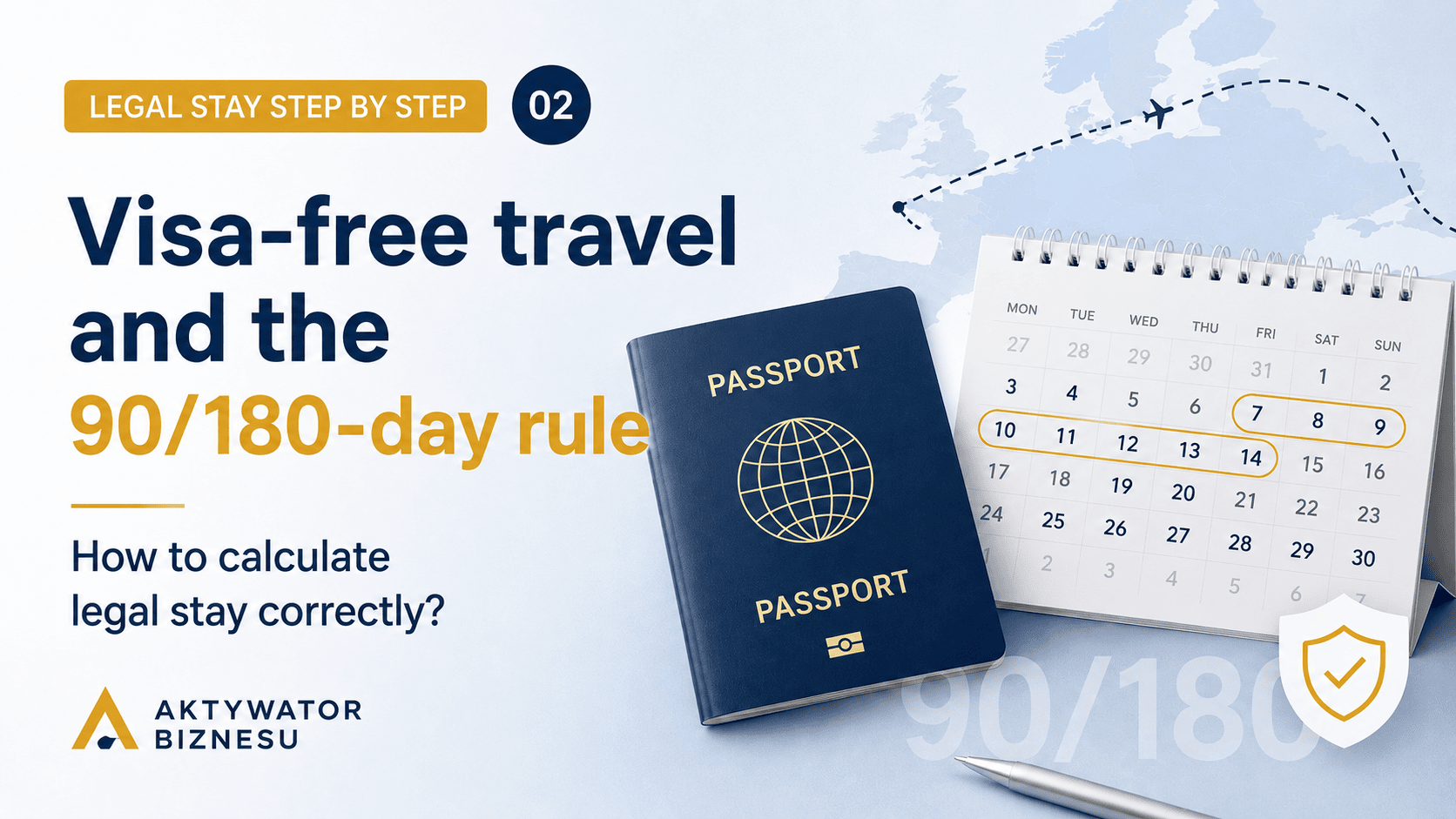
Visa-Free Travel and the 90/180-Day Rule — How to Calculate Your Legal Stay Correctly
LEGAL STAY STEP BY STEP · 02/12
Key rules of the 90/180-day limit
Check now
- ✅ Do I know all the dates of my stays from the last 180 days?
- ✅ Have I included stays in all Schengen countries?
- ✅ Have I counted both the entry day and the exit day?
- ✅ Have I checked the result in the official Schengen calculator?
- ✅ Have I not already exceeded the allowed limit?
Not sure how many days of legal stay you have left? Let’s work it out together.
BOOK A CONSULTATIONIn this series
- Is my stay legal?
- The 90/180-day rule
- Visa, decision, and residence card
- When to submit your application
- Legality during proceedings
- Passport stamp
- Leaving and re-entering Poland
- Change of address and situation
- Legal stay vs. legal work
- Job change or loss
- Choosing your next basis of stay
- Residence legality audit
How to check how many days you can still stay in Poland and the Schengen area?
Visa-free travel does not mean you can stay in Poland without any time limit. A foreigner making use of a short-term stay may, as a general rule, stay in the territory of the Schengen area countries for a maximum of 90 days in any rolling 180-day period.
The limit includes your total stay in all Schengen countries, not just Poland. Both the day of entry and the day of exit must be counted. This rule is often misunderstood — it does not mean 90 days per calendar half-year, 90 days from the start of the year, a fresh 90 days after each entry, or an automatic renewal of the limit after a short trip.
Need help calculating your limit? Find out how legalizing your stay in Poland works with Aktywator Biznesu.
Table of Contents
- What is visa-free travel?
- What is the 90/180-day rule?
- Does the day of entry and exit count toward the limit?
- Does only your stay in Poland count?
- Does a short trip reset the limit?
- Examples of calculating days of stay
- How to calculate your days of stay yourself?
- How to use the Schengen calculator?
- Applying for a residence permit and the 90/180 limit
- What happens if you exceed the 90 days?
- Common mistakes when calculating the 90/180 days
- Summary
What is visa-free travel?
Visa-free travel allows citizens of certain countries to come to the Schengen area without first obtaining a short-term visa. However, it does not mean a complete exemption from entry conditions — travelers must, among other things, hold a valid travel document and meet the other requirements for short-term entry. For citizens of many countries, using visa-free travel requires holding a biometric passport.
This article is intended primarily for people who use visa-free travel or a Schengen type C visa, who frequently enter and leave the Schengen area, who travel between several European countries, who are planning to re-enter Poland, who do not know how many days of legal stay they have left, who are ending a stay based on a national visa or a residence card and want to check whether a further short-term stay is possible, or who have submitted an application for a residence permit and are planning to leave Poland.
What is the 90/180-day rule?
The 90/180 rule means that within any period of 180 consecutive days, the total of all short-term stays cannot exceed 90 days. The 180-day period is rolling — it does not start automatically on 1 January, 1 July, on the day of first entry, or after each subsequent border crossing. For each day of stay, you need to look back 180 days and count all the days spent in the Schengen area during a short-term stay.
The simplest rule
Within any 180-day period under review, you can use a maximum of 90 days of short-term stay. This may be one continuous stay of up to 90 days, several shorter stays, or multiple trips whose total number of days does not exceed 90.
Why is the 180-day period called “rolling”?
The period is rolling because it shifts every day. If you want to check the legality of your stay on 20 August, you analyze the 180 days ending on 20 August. If you check the situation on 21 August, the period under review shifts by one day — the oldest day may fall out of the calculation, and the current day is added. That is why the result can change every day. Days are not all restored at once — they are recovered gradually, as earlier stays stop falling within the 180-day period under review.
This is not 90 days per calendar half-year
One of the most common mistakes is dividing the year into two periods — from 1 January to 30 June and from 1 July to 31 December. The 90/180 rule does not work that way. A foreigner who has used 90 days by the end of June does not automatically receive a new full limit on 1 July. Likewise, the start of a new calendar year does not reset earlier stays to zero. You always analyze the 180 days preceding a specific day of stay or inspection.
Does the day of entry and exit count toward the limit?
Yes. The day of entry is treated as the first day of stay, and the day of exit as the last day of stay.
Example
Entry into the Schengen area: 1 May. Exit from the Schengen area: 10 May.
1 May is the first day, and 10 May is the tenth day. The total stay is therefore 10 days, not 9.
Does only your stay in Poland count?
No. The limit applies to your total stay in the countries covered by the Schengen short-term stay rules. If a foreigner stayed 25 days in Poland, 15 days in Germany, 10 days in France, and 10 days in Italy, they have used a total of 60 days of short-term stay. It does not matter that they stayed only 25 days in Poland — the calculation takes into account the entire stay in the Schengen area. Crossing from Poland into Germany or the Czech Republic does not start a new stay — it is still a stay within the Schengen area.
Does a short trip reset the limit?
No. Leaving the Schengen area for a day, a weekend, or a few days does not automatically grant a new 90 days. After re-entering, you still need to take into account stays from the last 180 days. New days appear gradually, as the oldest days of an earlier stay fall outside the period under review. A foreigner who has used the full 90 days of stay and left the Schengen area will not automatically have the right to another 90 days after a week — to determine the earliest possible date of return, the dates of the earlier stay must be analyzed.
The calculation of the limit includes all short-term stays — whether under visa-free travel, a Schengen type C visa, or other short-term stays subject to the 90/180 rule. An earlier stay on a Schengen visa can therefore reduce the number of days later available under visa-free travel. However, periods permitted under a valid residence permit or a valid long-term visa (national type D visa) are not included — this does not mean, however, that after they end, everyone automatically has the right to remain for another 90 days.
Examples of calculating days of stay
Example 1: one continuous stay
A foreigner entered the Schengen area on 1 March and had not previously used a short-term stay within the period under review. If they remain without interruption, 29 May is their ninetieth day, and 30 May would be the ninety-first day — the stay should therefore end at the latest on 29 May. This example cannot be applied automatically if the foreigner had previously traveled within the Schengen area.
Example 2: several stays
A foreigner stayed in the Schengen area from 1 to 20 January (20 days), from 10 to 29 March (20 days), and from 1 to 30 June (30 days) — a total of 70 days. If all these stays still fall within the 180-day period under review, they have a maximum of 20 days of short-term stay left. Before the next entry, however, the exact rolling 180-day period should be checked, as some of the oldest days may have already fallen out of the calculation.
Example 3: travel through several countries
A foreigner stayed 15 days in Poland, 7 days in the Czech Republic, 12 days in Germany, and 6 days in Austria — a total of 40 days used. Crossing between these countries does not interrupt the stay within the Schengen area, so all 40 days must be counted toward the limit.
Example 4: weekend trip
A foreigner stayed in Poland for 80 days, then left for three days to a country outside the Schengen area and returned to Poland. Upon return, they do not receive a new limit of 90 days — if all the previous 80 days still fall within the 180-day period under review, they generally have only 10 days of short-term stay left.
How to calculate your days of stay yourself?
Step 1. Write down all the dates
Prepare the dates of every entry and exit from the Schengen area, stays based on visas and residence cards, and stays in other Schengen countries. Do not limit yourself to stamps from the Polish border.
Step 2. Determine the basis of each stay
Note whether a given period is a stay under visa-free travel, a Schengen type C visa, a national type D visa, a residence card, during a residence procedure, or on another basis — not all periods count toward the limit in the same way.
Step 3. Count every day
Include the day of entry, each day of stay, and the day of exit.
Step 4. Look back 180 days
For the day you want to check, analyze the 180-day period ending on that day and add up all the days of short-term stay falling within that range.
Step 5. Check the result
If the total is less than 90 days, part of the limit may remain unused. Exactly 90 days means the limit has been used up. More than 90 days may mean that the permitted stay has been exceeded. The arithmetic alone is not always enough — each period of stay must also be correctly classified.
How to use the Schengen calculator?
The European Commission provides an official short-term stay calculator. It allows you to check whether your stay so far complies with the 90/180 rule, estimate the number of days remaining, check a planned period of stay, and analyze several earlier trips. The calculator has two modes: a control mode, used to assess past or ongoing stays, and a planning mode, which helps check the possible length of a future stay from a given entry date.
It is important to remember that the calculator is only a supporting tool. The European Commission points out that the calculator’s result does not in itself create a right of residence. If the dates are entered incorrectly or an earlier stay is omitted, the result will also be wrong — the calculator will not detect documents or trips that the user has not entered.
What documents should you prepare to calculate your stay?
It may be useful to have: your current and previous passports, copies of pages with stamps, visa stickers, boarding passes, plane, train, and bus tickets, booking and border-crossing confirmations, residence documents, decisions on permits, confirmations of applications submitted, and other documents that help reconstruct your travel. When traveling between Schengen countries, there is often no border control or stamps — so the absence of a stamp does not mean that stay does not have to be counted.
Applying for a residence permit and the 90/180 limit
A stay in Poland during a properly conducted procedure may be legal under the provisions relating to the application submitted. However, this does not automatically mean that such a period grants the right to travel around other Schengen countries, to re-enter Poland after leaving, to start a new visa-free limit, or to disregard the history of earlier short-term stays. The Border Guard notes that, when assessing re-entry, total earlier short-term stays may be relevant, including stays under visa-free travel, on a type C visa, and certain periods of stay during the procedure.
Does submitting an application for a residence permit give you a new 90 days? No. Submitting an application for a residence permit does not renew the 90/180 limit. However, once the statutory conditions are met, it may allow for a further legal stay in the territory of Poland during the procedure — this is nevertheless a separate basis for the legality of stay, not a new period of visa-free travel. The legality of continued stay depends, among other things, on the application being submitted during a legal stay, being properly filed, formal deficiencies being remedied, and the procedure remaining ongoing.
Can you travel while waiting for a decision? A distinction must be made between the legality of continued stay in Poland, the ability to leave Poland, the ability to stay in other Schengen countries, and the ability to re-enter Poland. A properly submitted application may legalize continued stay in Poland, but it is not automatically a visa, a residence card, or a document allowing free return after leaving. Before traveling, you should not rely solely on the fact that your residence case is pending.
What happens if you exceed the 90 days?
Exceeding the permitted period of stay can lead, among other things, to further stay being considered illegal, the initiation of return proceedings, problems during checks or when leaving the Schengen area, restrictions on the possibility of re-entry, and negative consequences in later visa or residence matters. You should not assume that exceeding the limit by a few days will be treated as insignificant — if the limit has been exceeded, the exact dates and circumstances should be analyzed, rather than simply assuming that leaving and re-entering will be enough.
If the permitted period of stay is coming to an end, you should precisely calculate the remaining limit, check the basis of your current stay, determine whether you can apply for a residence permit, prepare documents before the legal stay expires, check the impact of a planned departure, and not wait until the last day. Merely preparing an application, booking an appointment, or gathering documents does not extend your stay.
Common mistakes when calculating the 90/180 days
Counting only the stay in Poland
The limit also includes stays in other Schengen countries.
Omitting the day of entry or exit
Both days generally count as days of stay.
Counting from the start of the year
The 180-day period is rolling and is not tied to the calendar year.
Expecting a new limit after every entry
A subsequent entry does not start a new 90 days.
Assuming a weekend trip resets the limit
A short trip does not automatically renew days already used.
Overlooking an earlier Schengen visa
Stays on a type C visa and under visa-free travel can add up together.
Treating the stay in each country separately
The limit is shared across the entire Schengen area.
Relying solely on passport stamps
Many borders within the Schengen area are crossed without checks or stamps.
Using the calculator without reflection
The calculator will not detect documents or trips that the user has not entered.
Summary
The 90/180-day rule means that a foreigner may stay short-term in the Schengen area for a maximum of 90 days within any rolling 180-day period. The limit applies to the entire Schengen area, the 180-day period shifts every day, the day of entry and the day of exit are both counted, short-term stays can add up, a new year does not renew the limit, re-entry does not start a new 90 days, and a short trip does not reset an earlier stay to zero. Periods of stay under a residence permit or a long-term visa are generally not included in the short-term limit, and the calculator’s result is an aid, not independent confirmation of the right to enter or stay. In cases involving multiple entries, different visas, a stay based on a card, or an ongoing procedure, the calculation may require individual analysis.
Checklist before a planned entry
- Does my citizenship allow me to use visa-free travel?
- Do I hold the required travel document, and is it valid?
- Do I know all the dates of my stays from the last 180 days, taking into account all Schengen countries?
- Have I counted the day of entry and the day of exit, and taken earlier type C visas into account?
- Have I checked the result in the official calculator, and do I have documents confirming my travel history?
- Have I not already exceeded the allowed limit?
Checklist before a planned departure from Poland
- On what basis are you currently staying in Poland?
- Do you hold a valid visa or a valid residence card?
- Can you use visa-free travel, and how many days remain within the 90/180 limit?
- Could the planned departure affect an ongoing procedure?
- Will you be able to re-enter Poland?
- Does the destination country have additional entry requirements?
Not sure how to calculate your legal stay?
Aktywator Biznesu will review your travel history, documents, and current basis of stay. We will also check whether a planned departure or re-entry could affect your situation.
Phone: 500 851 891
Email: biuro@aktywatorbiznesu.com
Address: ul. Szlak 77/222, 31-153 Kraków
Remote working hours: 8:00 AM – 8:00 PM
Languages: Polish, English, and Ukrainian
Legal status of the article: 27 July 2026. This article is for general informational purposes only. It does not replace an individual analysis of a specific foreigner’s documents, travel history, or basis of stay.