Can You Leave Poland While Waiting for a Residence Card?
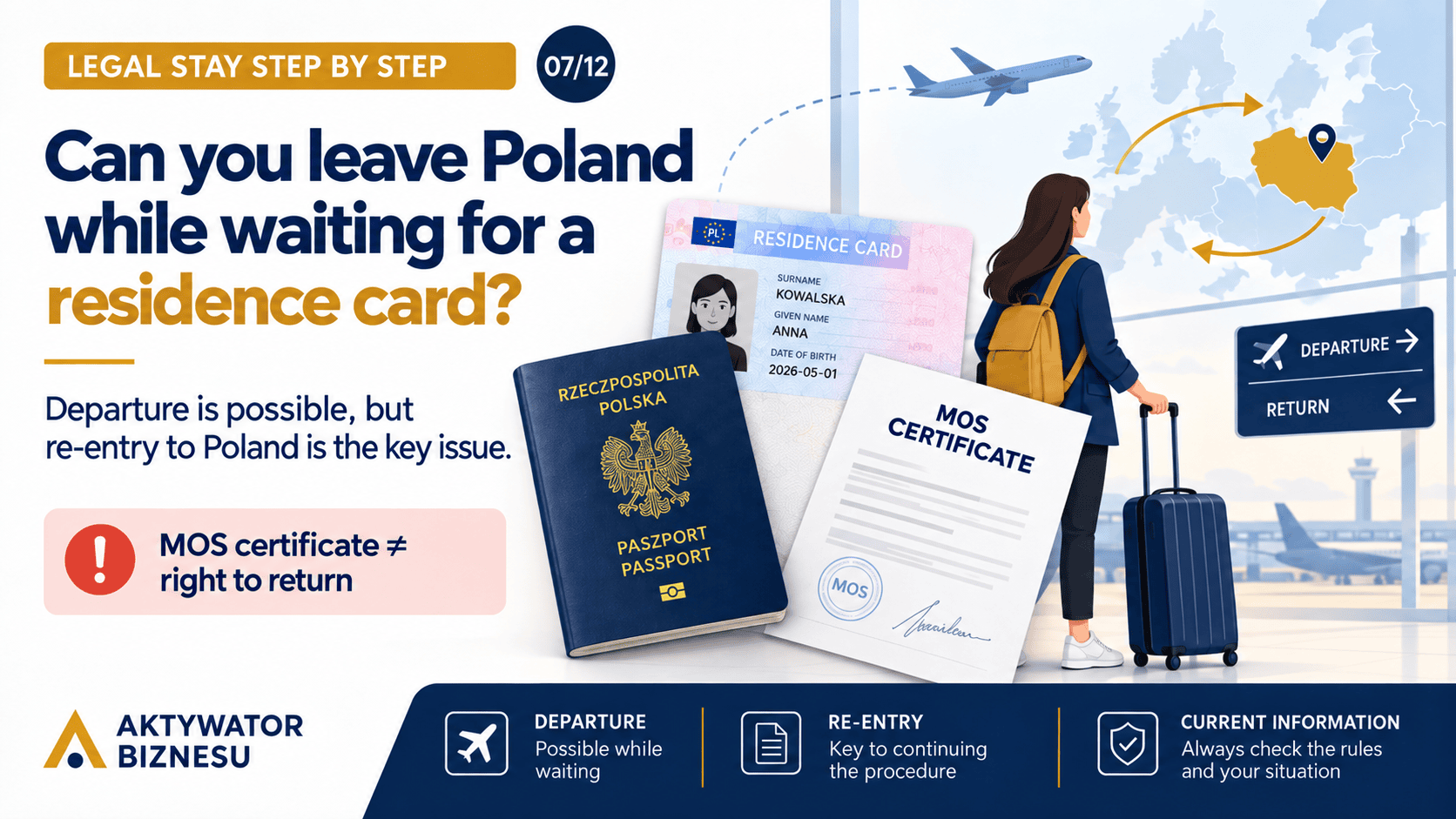
A foreign national waiting for a decision can, as a rule, leave Poland. What matters, however, is not leaving the country itself, but whether they will have a valid basis for re-entry on the day they plan to return.
Key takeaway
A foreign national waiting for a decision can, as a rule, leave Poland. What matters is not leaving the country itself, but having a valid basis to re-enter. The MOS certificate is neither a visa nor a residence card, and on its own it does not give the right to return to Poland or to travel freely within Schengen.
That’s why, before leaving, you need to check three separate things:
Is your stay in Poland legal?
Establish your current basis of stay and the stage of your proceedings.
Can you leave Poland?
The residence proceedings themselves generally do not block your departure.
On what basis will you return?
Check whether you have a valid card, visa, visa-free travel, or another basis for entry.
Who is this article for?
This material is intended for foreign nationals who:
- have submitted a residence application through MOS;
- are waiting for the voivode’s decision;
- hold a MOS certificate;
- no longer have a valid residence card, or whose visa is about to expire;
- rely on visa-free travel;
- are planning a trip to their home country or another Schengen state;
- want to return to Poland after a short trip.
4 things worth remembering
Check before you buy a ticket
- ✅ I know what basis I am currently staying in Poland on
- ✅ I have checked the validity of my card, visa, or 90/180 limit
- ✅ I have a confirmed basis for re-entry
Planning a trip while waiting for your residence card? Let’s check it together before you buy a ticket.
BOOK A CONSULTATIONIn this series
- Is my stay legal?
- The 90/180-day rule
- Visa, decision and residence card
- When to submit your application
- I applied for a residence card – is my stay still legal?
- MOS Certificate
- Leaving during the wait for a residence card
- Change of address and situation
- Legal stay vs. legal work
- Changing employer during temporary residence
- Job change or loss
- Residence legality audit
Table of Contents
- 1. Can you leave Poland during proceedings?
- 2. Does a MOS certificate let you return to Poland?
- 3. When can you return on the basis of a valid residence card?
- 4. Can you return on the basis of a valid visa?
- 5. Can you return under visa-free travel?
- 6. Does time spent “in the procedure” count toward the 90/180 days?
- 7. What if I used the full 90 days and then leave?
- 8. Can I travel from Poland to Germany, Czechia, or another Schengen country?
- 9. Can I fly via another Schengen country?
- 10. Is a direct flight to Poland safer?
- 11. Does leaving interrupt the residence proceedings?
- 12. Do I need to monitor MOS while I’m away?
- 13. Can a representative handle everything while I’m away?
- 14. Does leaving affect my right to work?
- 15. Can I collect my residence card after returning?
- 16. What should I do if my residence card expires while I’m away?
- 17. What should I do if I learn abroad that my permit has been revoked?
- 18. How do I check my situation before leaving?
- 19. Example 1 – a valid residence card
- 20. Example 2 – expired visa, proceedings ongoing
- 21. Example 3 – visa-free allowance not yet used
- 22. Example 4 – the 90 days already used
- 23. The most common mistakes before leaving
- 24. Checklist before leaving Poland
- 25. Documents worth having while travelling
1. Can you leave Poland during proceedings?
Yes. The mere fact that proceedings for a residence permit are ongoing does not mean you are banned from leaving Poland. A foreign national can travel to their home country, to a country outside Schengen, or to another Schengen state, provided they have a separate basis for doing so.
Leaving can, however, have practical consequences for the possibility of re-entry, official deadlines, being summoned to appear in person, receiving correspondence, and the further handling of your case.
2. Does a MOS certificate let you return to Poland?
No. A MOS certificate can document the legality of your stay in Poland during proceedings, but it is not a visa, a residence card, a travel document, or an independent basis for re-entry.
So a situation is possible where a foreign national legally stays in Poland solely because of ongoing proceedings, but after leaving has no document that allows them to come back.
Remember this
A MOS certificate is not a document for re-entry. Before leaving, always establish a separate basis for returning to Poland.
3. When can you return on the basis of a valid residence card?
If your residence card remains valid, the situation is usually the simplest. A valid residence card together with a valid travel document can serve as the basis for crossing the Polish border multiple times without needing a visa.
Before leaving, check the expiry date of your card and passport, whether your permit has been revoked, and whether your card will still be valid on the day you plan to return.
4. Can you return on the basis of a valid visa?
Yes, if your visa is still valid and allows re-entry. Check the visa type, its period of validity, the number of entries allowed, the number of days remaining, its territorial scope, and your passport’s validity.
A national type D visa can serve as a basis for returning to Poland, provided it is still valid. For a Schengen type C visa, you also need to check your 90/180-day limit.
5. Can you return under visa-free travel?
Yes, but only if the foreign national holds a nationality entitled to visa-free travel, has the required travel document, meets the conditions for entry, and has a remaining allowance under the 90/180 limit.
The mere fact that residence proceedings are ongoing does not renew your visa-free travel allowance.
6. Does time spent “in the procedure” count toward the 90/180 days?
This issue requires careful analysis. A foreign national who submitted an application during a short-term stay first uses up whatever short-term stay they had remaining. Only once that is exhausted can they stay in Poland solely on the basis of the provisions linked to ongoing proceedings.
When assessing the possibility of re-entry, you need to establish when the short-term stay was used, when the stay based solely “on the procedure” began, and how many days fall within the 180-day period being analysed.
7. What if I used the full 90 days and then leave?
If a foreign national used the full short-term stay allowance and then remained in Poland legally solely on the basis of ongoing proceedings, after leaving they cannot assume an automatic return under visa-free travel or an ordinary type C visa.
Returning may require an appropriate visa or waiting outside Schengen for a sufficient period.
8. Can I travel from Poland to Germany, Czechia, or another Schengen country?
Not on the basis of a MOS certificate alone. The certificate concerns the legality of your stay on Polish territory and, on its own, does not give the right to move around other Schengen states.
The possibility of such a trip must be based on a separate ground, for example a valid residence card, a valid visa, or an available visa-free travel allowance.
Most common mistake
“My stay in Poland is legal, so I can fly to another Schengen country for the weekend.” Legal stay in Poland during a procedure is not the same as the right to travel freely within Schengen.
9. Can I fly via another Schengen country?
A route like this needs to be analysed very carefully. On a trip such as Kraków – Frankfurt – home country, or home country – Amsterdam – Kraków, the first crossing of Schengen’s external border may take place outside Poland.
If a foreign national does not hold a document that allows entry into the Schengen area, a problem can already arise in the transit country.
10. Is a direct flight to Poland safer?
If a foreign national is returning on the basis of a document or entitlement relating to Poland, a direct flight can be procedurally simpler than entering through another Schengen country.
This does not mean, however, that a direct flight by itself creates a right of entry. You still need an appropriate basis: a visa, a valid residence card, the possibility of visa-free entry, or another document.
11. Does leaving interrupt the residence proceedings?
Not automatically. Simply leaving Poland does not automatically end the proceedings. It can, however, cause practical problems.
During this time, the office may summon the foreign national to appear in person, request that they present their passport, set a deadline for completing documents, or send other important correspondence.
12. Do I need to monitor MOS while I’m away?
Yes. Leaving does not release you from the obligation to monitor your proceedings. While staying abroad, you should regularly check MOS, e-Doręczenia, your email, paper correspondence, and any information from your representative.
13. Can a representative handle everything while I’m away?
Not always. A representative can carry out many procedural actions, but cannot stand in for the foreign national wherever an in-person appearance, presenting a travel document, taking fingerprints, or another personal action is required.
14. Does leaving affect my right to work?
Leaving itself neither grants nor automatically takes away the right to work. After returning, however, you should check whether all the conditions for legal employment are still met. What can matter includes the validity of your residence document, your basis for re-entry, any earlier entitlement to work, a change of employer, and the document legalising your employment.
15. Can I collect my residence card after returning?
If a decision has already been issued and the card is ready for collection, the foreign national still needs to be able to enter Poland legally in order to collect it. The mere information that the card is ready does not replace a visa or a document allowing you to cross the border.
16. What should I do if my residence card expires while I’m away?
If your card’s validity ends while you are staying outside Poland, you should not try to return on an expired document. Re-entry may require obtaining a visa or meeting the conditions for visa-free travel.
Before leaving, check not only whether your card is valid today, but also whether it will still be valid on the day you plan to return.
17. What should I do if I learn abroad that my permit has been revoked?
Revocation of a permit can lead to the need to invalidate and return your residence card. Before re-entering, make sure the card you hold can still serve as a basis for entering Poland. Physically holding the plastic card does not always mean the document is still valid.
18. How do I check my situation before leaving?
Check your passport
Will it be valid on both the day you leave and the day you return?
Check your residence card
Will the card still be valid on the day you return?
Check your visa
If your card isn’t valid, do you hold a visa that lets you return?
Check visa-free travel
Does your nationality allow it, and how many days do you have left under the 90/180 limit?
Check your route
Will you cross Schengen’s external border in Poland, or in another country?
Check MOS
Is the office expecting you to appear in person or to complete any documents?
19. Example 1 – a valid residence card
Situation
A foreign national holds a card valid until December, leaves in October, returns in November, and has a valid passport. As a rule, a valid card together with a valid passport can serve as the basis for re-entry, as long as the permit remains in force.
20. Example 2 – expired visa, proceedings ongoing
Situation
A foreign national held a type D visa until June, submitted a residence application before it expired, and in September is staying in Poland legally solely because of ongoing proceedings. They want to travel to their home country. A MOS certificate alone is not enough to return; a different basis for re-entry needs to be established.
21. Example 3 – visa-free allowance not yet used
Situation
A foreign national can rely on visa-free travel, has used only part of the 90/180 allowance, the residence proceedings are ongoing, and they want to leave Schengen for a week. Returning under visa-free travel may be possible if, on the day of re-entry, they still meet its conditions and have days remaining.
22. Example 4 – the 90 days already used
Situation
A foreign national used the full 90 days, then remained in Poland during the proceedings, and now wants to leave and return after a week. They cannot assume that a week’s stay outside Schengen grants a fresh 90 days. Returning may require an appropriate visa or waiting outside Schengen for the proper period.
23. The most common mistakes before leaving
- buying a ticket before checking your right to return;
- treating a MOS certificate as a residence card;
- checking only the possibility of leaving, not of returning;
- travelling through another Schengen country without checking the entry conditions;
- miscalculating the 90/180 limit;
- leaving right before a possible summons from the office;
- not monitoring MOS while staying abroad.
24. Checklist before leaving Poland
Check before you buy a ticket
- ✅ Is my passport valid?
- ✅ On what basis am I currently staying in Poland?
- ✅ Do I have a valid residence card, and will it still be valid on the day I return?
- ✅ Do I have a valid visa?
- ✅ Can I rely on visa-free travel, and how many days do I have left under the 90/180 limit?
- ✅ Is a MOS certificate the only document I currently hold?
- ✅ In which country will I cross Schengen’s external border?
- ✅ Might the office require me to appear in person?
- ✅ Will I monitor MOS during my trip?
- ✅ Do I have a confirmed basis for re-entry?
If your answer to the last question is “I don’t know” – it’s not worth buying a ticket before checking your situation.
25. Documents worth having while travelling
- a valid passport;
- a valid residence card or visa, if it forms the basis for entry;
- a copy of the decision;
- your UPO;
- your MOS certificate;
- documents confirming the course of your proceedings;
- evidence of earlier trips, if needed to calculate the 90/180 limit;
- your representative’s contact details.
Remember
Having a copy of your entire file does not replace the document required to cross the border.
Summary
You can leave Poland while waiting for a residence card, but every trip should be analysed above all from the perspective of whether you’ll be able to return.
- ongoing proceedings do not mean a ban on leaving;
- a MOS certificate is neither a visa nor a residence card;
- the certificate alone does not allow re-entry into Poland;
- the certificate does not give the right to travel freely within Schengen;
- a valid residence card together with a passport can allow multiple entries;
- once the card expires, you may need a visa or the possibility of using visa-free travel;
- visa-free travel requires correctly calculating the 90/180 limit;
- leaving does not automatically end the proceedings;
- while staying abroad you still need to monitor MOS;
- before travelling, check both your departure and your route back in.
Planning a trip while waiting for your residence card?
Aktywator Biznesu can review your current basis of stay, the validity of your visa and card, your available 90/180 allowance, your MOS certificate, the possibility of re-entry, your travel route through other Schengen countries, and the current stage of your proceedings before you travel. Service in Polish, English, and Ukrainian. Remote working hours: 8:00 AM – 8:00 PM. Phone +48 500 851 891, biuro@aktywatorbiznesu.com.
Previous article in the series: MOS Certificate – What Does It Confirm and What Does It Not Authorize?
Next article in the series: Change of Address, Voivodeship, or Family Situation – What Needs to Be Reported?
Official sources:
- Office for Foreigners – information on the rules for re-entry and visa-free travel
- Case Handling Module (MOS) – information on certificates and monitoring your proceedings
This article is for general information only. It does not replace an individual analysis of documents, travel history, border-crossing conditions, or a foreign national’s specific residence situation. Legal status of this article: 7 September 2026.