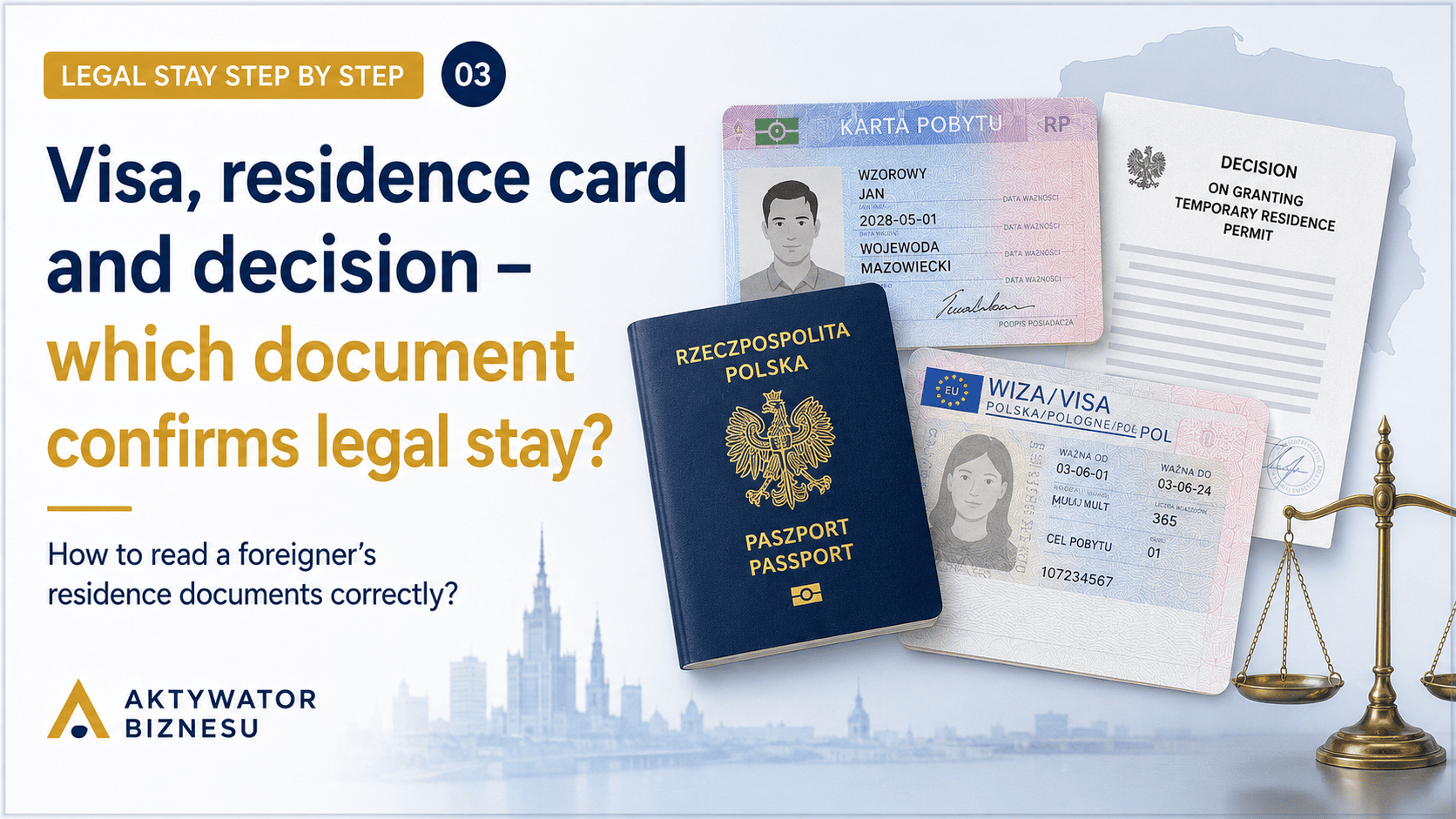
Visa, Decision, and Residence Card — Which Document Confirms Your Legal Stay?
A visa, a decision, a residence permit, and a residence card all serve different functions. To correctly assess your situation, you need to check the whole set of documents, their dates, the purpose of your stay, and the history of the procedure.
Foreign nationals often use the terms visa, residence permit, decision, and residence card interchangeably. However, these documents serve different functions and do not always grant the same rights. A visa may allow entry and stay for a specific period. An administrative decision determines whether a foreign national has been granted a residence permit. A residence card is a document issued after obtaining a particular residence entitlement. A confirmation of a submitted application, in turn, may confirm the legality of continued stay in Poland during the procedure, but it does not replace a visa or a residence card.
To assess your situation, check: your passport, visa, decision, residence card, confirmation of a submitted application, expiry dates, purpose of stay, and your history of entries and exits.
Who is this article for?
This article is for people who:
- hold a type C or type D visa
- have received a decision from the voivode
- are waiting for their residence card to be issued
- have submitted an application for a residence permit
- are not sure whether they can leave Poland
- are not sure whether their residence card still reflects their current situation
- have changed jobs, address, or purpose of stay
- want to check which document to present during a check or when crossing the border
Four documents you should not confuse
Check now
- ✅ Do I have a valid passport and a visa or residence card?
- ✅ Have I checked the expiry date of each document?
- ✅ Have I kept a copy of the administrative decision?
- ✅ Do I have a confirmation from MOS if I submitted an application?
- ✅ Is the information consistent across all documents?
Not sure which document currently confirms your legal stay? Let’s find out together.
BOOK A CONSULTATIONIn this series
- Is my stay legal?
- The 90/180-day rule
- Visa, decision, and residence card
- When to submit your application
- Legality during proceedings
- Passport stamp
- Leaving and re-entering Poland
- Change of address and situation
- Legal stay vs. legal work
- Job change or loss
- Choosing your next basis of stay
- Residence legality audit
Table of Contents
- Who is this article for?
- Schengen Type C Visa
- Polish National Type D Visa
- Decision Granting a Residence Permit
- Residence Card
- Residence Card vs. an Indefinite Permit
- I’ve Submitted a Residence Application – Is My Stay Legal?
- Does a Case Number Confirm Legal Stay?
- Is Proof of Submission Enough?
- Can I Travel Without a Residence Card After a Positive Decision?
- Does a Residence Card from Another Schengen State Let Me Live in Poland?
- Documents That Are Not a Residence Card or a Visa
- How to Check Which Document Currently Legalizes Your Stay
- Common Mistakes
- Document Checklist
- Summary
1. Schengen Type C Visa
A Schengen type C visa is a short-stay visa. It allows one or several stays that together may not exceed 90 days within any 180-day period. It may be valid throughout the entire Schengen area or only in the territory of specified states, if it has limited territorial validity.
On a type C visa, check: the period of validity, the maximum number of days of stay, the number of entries allowed, the territorial scope, the purpose for which it was issued, and the holder’s details.
What should you check on a type C visa?
- the “valid from” field
- the “valid until” field
- the number of days of stay
- the number of entries
- the territorial scope
- the purpose for which the visa was issued
- the holder’s details
Example: A visa may be valid from 1 March to 31 May, but only allow 30 days of stay. This does not mean a right to stay for the entire three months.
Does a type C visa confirm the right to work?
Not always. The ability to work also depends on the purpose for which the visa was issued, holding a document that legalizes employment, and any exemption from the requirement to hold a work permit. A valid visa alone is not always sufficient for legal employment.
2. Polish National Type D Visa
A national type D visa allows a stay in Poland for the period shown on the visa sticker. It may cover one continuous stay or several consecutive stays whose total length exceeds 90 days. The validity period of a Polish national visa may not exceed one year. The exact number of days allowed is shown on the visa sticker.
What does a type D visa give you?
- entry into Poland
- stay in Poland during its period of validity
- multiple border crossings, if the visa allows it
- short-term travel to other Schengen states within the applicable limits
- the ability to work, if separate employment conditions are met
What should you check?
- the start date of validity
- the end date of validity
- the number of days of stay
- the number of entries allowed
- the purpose for which it was issued
- the territorial scope
Most common mistake: Checking only the visa’s end date. Legal stay also requires that the number of days shown on the visa has not been used up.
3. Decision Granting a Residence Permit
A decision is an official ruling issued by an administrative authority. It may concern a temporary residence permit, a permanent residence permit, an EU long-term resident permit, a refusal to grant a permit, or the withdrawal of an earlier permit.
After obtaining the permit, a residence card is issued to the foreign national.
What does the decision contain?
- the type of permit
- its period of validity
- the purpose of stay
- the legal basis
- conditions relating to employment
- the employer’s details
- the position
- the remuneration
- the working time
- instructions on appeal
- the foreign national’s obligations
Keep the decision: A residence card does not always show the full scope of the permit, so the decision should be kept for the entire period it remains valid.
Is a positive decision the same as a residence card?
No. A positive decision means a specific permit has been granted. A residence card is the document issued after obtaining that residence entitlement and meeting the conditions for its issue.
4. Residence Card
A residence card is a residence document issued to a foreign national who has obtained a specific permit or holds another basis provided for by law.
During its period of validity, the card confirms the foreign national’s identity. Together with a valid travel document, it may allow multiple border crossings without the need to obtain a visa.
What is on the residence card?
- first and last name
- date of birth
- citizenship
- sex
- document number
- date of issue
- expiry date
- the name of the issuing authority
- the type of entitlement granted
- annotations, e.g. “access to the labor market”
A residence card does not replace a passport: When crossing the border, a foreign national should hold a valid residence card and a valid passport.
Does a card with the annotation “access to the labor market” allow you to work anywhere?
Not always. The detailed rights may depend on the type of permit, the content of the decision, special provisions, and the foreign national’s current situation.
Is the card still valid after a change of job?
The date on the card itself may not change immediately after a change in professional situation. Depending on the type of permit, it may be necessary to notify the voivode, amend the permit, submit a new application, or establish a new basis for legal work.
5. Residence Card vs. an Indefinite Permit
In the case of a permanent residence permit and an EU long-term resident permit, the permit itself may be granted for an indefinite period, but the residence card has a set expiry date.
The card’s expiry does not necessarily mean the permit has expired, but an invalid card may make it impossible to properly use the document. An application to replace the card should be filed sufficiently in advance.
6. I’ve Submitted a Residence Application – Is My Stay Legal?
If the application was filed during a legal stay, filed correctly and without formal deficiencies, or any deficiencies were corrected within the deadline, continued stay may be treated as legal from the day the application was filed until the day the decision becomes final.
Important change since 27 April 2026: Voivodes no longer place a new stamp in the passport. Instead, a certificate confirming that the application was filed is issued, available in the foreign national’s account in the Case Handling Module (MOS).
What can the certificate confirm?
- that the application was filed during a legal stay
- that it met the formal requirements
- that formal deficiencies were corrected within the deadline
- that the stay in Poland is treated as legal during the procedure
What does the certificate not replace?
- a visa
- a residence card
- a passport
- a travel document
- a guarantee of re-entry into Poland
- a positive decision on the residence case
7. Does a Case Number Confirm Legal Stay?
No. A case number alone only means that the case has been registered with the authority. On its own, it does not confirm that the application was filed during a legal stay, that it was complete, that deficiencies were corrected on time, that the foreign national has the right to work, or that they may re-enter Poland.
8. Is Proof of Submission Enough?
Proof that a parcel was sent is important evidence, but on its own it does not always determine the legality of stay. You need to establish what was sent, when it reached the authority, whether the application was signed, whether it contained the required elements, and whether any deficiencies were corrected on time.
9. Can I Travel Without a Residence Card After a Positive Decision?
The paper decision alone does not replace a valid residence card or visa when crossing the border. Before traveling, a person with a positive decision but no card should check the validity of their visa, whether they can use visa-free travel, their remaining 90/180 limit, and any other basis for re-entry.
10. Does a Residence Card from Another Schengen State Let Me Live in Poland?
A residence card issued by another Schengen state may allow short-term entry into Poland, but as a rule it does not automatically grant the right to live or work in Poland long-term. For a longer stay, it may be necessary to obtain a Polish residence entitlement.
11. Documents That Are Not a Residence Card or a Visa
Karta Polaka (Pole’s Card)
Confirms belonging to the Polish Nation, but it is not a visa, a residence card, a residence permit, or a standalone document allowing you to cross the border.
PESEL number
Used to identify a person in Polish registers. It is not a standard residence document. The special PESEL UKR status requires separate analysis, as the entitlements arise from special provisions.
Address registration (meldunek)
Confirms that a place of stay at a given address has been reported. It does not legalize stay.
Invitation (zaproszenie)
May confirm that financial means for stay and travel have been secured, but it is not a visa or a residence document.
Employment contract
Confirms an employment relationship, but it does not replace a legal basis for stay.
12. How to Check Which Document Currently Legalizes Your Stay
Step 1. Check your passport
- expiry date
- consistency of the data
- visas
- stamps or entry history
- earlier travel documents
Step 2. Check your visa
- whether it is a type C or D visa
- until when it is valid
- how many days of stay were granted
- how many days have been used
- whether it allows one or multiple entries
Step 3. Check the decision
- the type of permit
- the period
- the purpose of stay
- the employment conditions
- the date of delivery
- information on finality
- the instructions
Step 4. Check the residence card
- expiry date
- type of document
- annotations
- consistency with the passport data
- connection to the decision
Step 5. Check the documents from the procedure
- MOS certificate
- confirmation of application submission
- summonses
- confirmations of corrected deficiencies
- information on case status
Step 6. Check for changes
- change or loss of job
- change of position or remuneration
- change of purpose of stay
- change in family situation
- a move
- a longer trip
13. Common Mistakes
- Confusing the decision with the residence card – the decision grants the permit, while the card is the document issued after obtaining it.
- Traveling with only the decision – a paper decision does not replace a passport, visa, or residence card when crossing the border.
- Checking only the date on the card – the content of the decision and changes in your situation can matter just as much.
- Treating the case number as confirmation of legality – a case number alone does not confirm that the conditions for legal stay have been met.
- Mistaking the certificate for a residence card – the certificate may confirm legal stay in Poland during the procedure, but it is not a travel document.
- Confusing the Karta Polaka with a residence card – these are two different documents.
- Not replacing the card after an indefinite permit – an indefinite permit does not mean the plastic card is valid indefinitely.
14. Document Checklist
- a valid passport
- a copy of the visa
- a copy of the decision
- the residence card
- the MOS certificate
- confirmation of the application submitted
- summonses from the authority
- confirmation of corrected deficiencies
- documents relating to employment
- travel history
- current address for correspondence
Summary
A visa, a decision, a permit, and a residence card all serve different functions. The key rules:
- a type C visa is used for short-term stays
- a type D visa allows a longer stay in Poland during its period of validity
- a decision determines whether a permit is granted
- a permit is the entitlement arising from the decision
- a residence card is the document issued after obtaining a residence entitlement
- a residence card does not replace a passport
- a decision does not replace the card when traveling
- since 27 April 2026, filing an application is confirmed by a certificate available in MOS, not a new stamp in the passport
- a case number is not sufficient proof of legal stay
- a full assessment requires analyzing the documents, deadlines, and the foreign national’s current situation
Not sure which document currently confirms your legal stay?
Aktywator Biznesu will review your visa, decision, residence card, MOS certificate, and procedural history. We will indicate which documents confirm your current situation and what further steps to take.
Phone: 500 851 891
Email: biuro@aktywatorbiznesu.com
Address: ul. Szlak 77/222, 31-153 Kraków
Remote working hours: 8:00 AM – 8:00 PM
Languages: Polish, English, and Ukrainian
Book a free initial consultationCall: 500 851 891Legal status of the article: 29 July 2026. This article is for general informational purposes only. It does not replace an individual analysis of a specific foreign national’s documents, decision, or basis of stay.